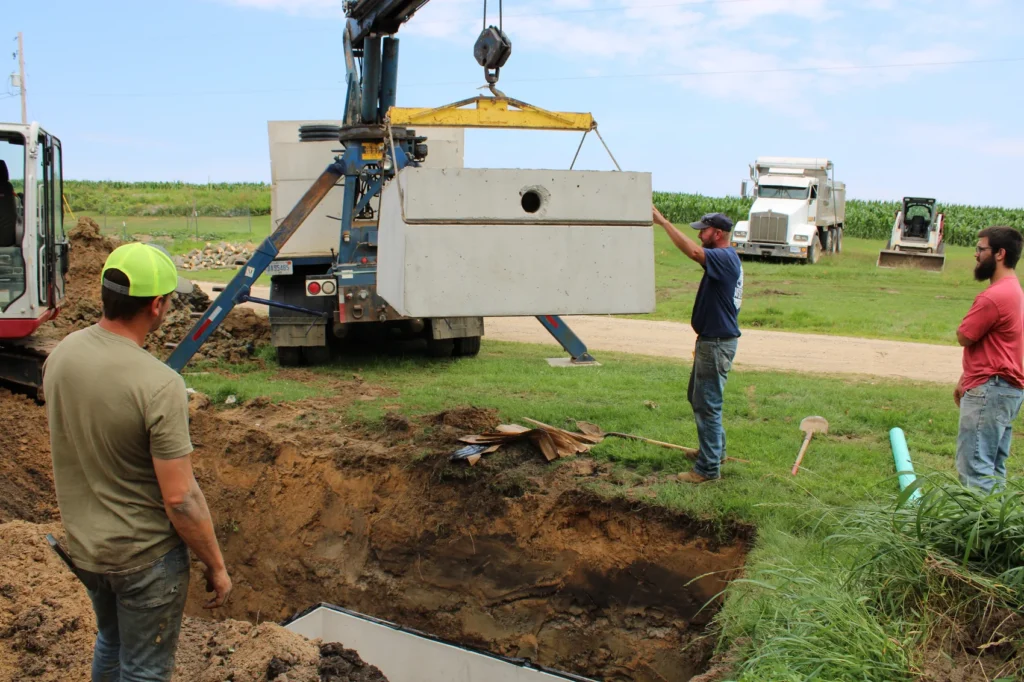
A 44-unit mobile home park. A 20,000-gallon septic tank. A drainfield that had quietly run out of room to fail. By November 2010, it was fixed and running.
That was the site Wray’s found in Allegan, and it turned into what’s now known as the first commercial aerobic treatment unit installed in the United States. Worth being precise about that claim up front: this was the first commercial installation, not the first residential one. The two get mixed up easily, and we’d rather set the record straight than let the shorthand version stick.
The Problem: A System That Couldn’t Keep Up
Wray’s had serviced the property’s 20,000-gallon tank for years, pumping it twice a year as routine maintenance. That rhythm held until a new owner took over the property and inherited a drainfield that was already failing.
The new owner wasn’t surprised by what they found. Sewage was reaching a swamp forest that drained into Swan Lake and was only visible up close. The Allegan County Health Department got involved. A fix was already underway before the department applied real pressure, and once officials saw that, they worked alongside Wray’s team instead of against it.
The deadline was still real: three months to design, get approval, and finance a full replacement system for all 44 units.
The Constraint: No Room for a Standard Fix
A standard septic replacement wasn’t on the table. The property sat on clay soils dense enough to rule out a conventional drainfield, and there wasn’t a clear patch of open land for one even if the soil had cooperated.
The property owner selected the engineer for the job: Randy Rapp, P.E., of Exxel Engineering in Grand Rapids, who today heads the Allegan County Health Department. Rapp’s approach was to build the new drainfield directly on top of the failing one instead of finding room beside it. This is what’s sometimes referred to as a “fusion” system, which describes the way the treatment process combines steps.
The Build: A Bigger Job Than Everyone Thought
By the Wray’s team’s own account, this wasn’t a technically harder job than a standard install. It was a bigger one, with more moving parts to coordinate across 44 units on a single deadline.
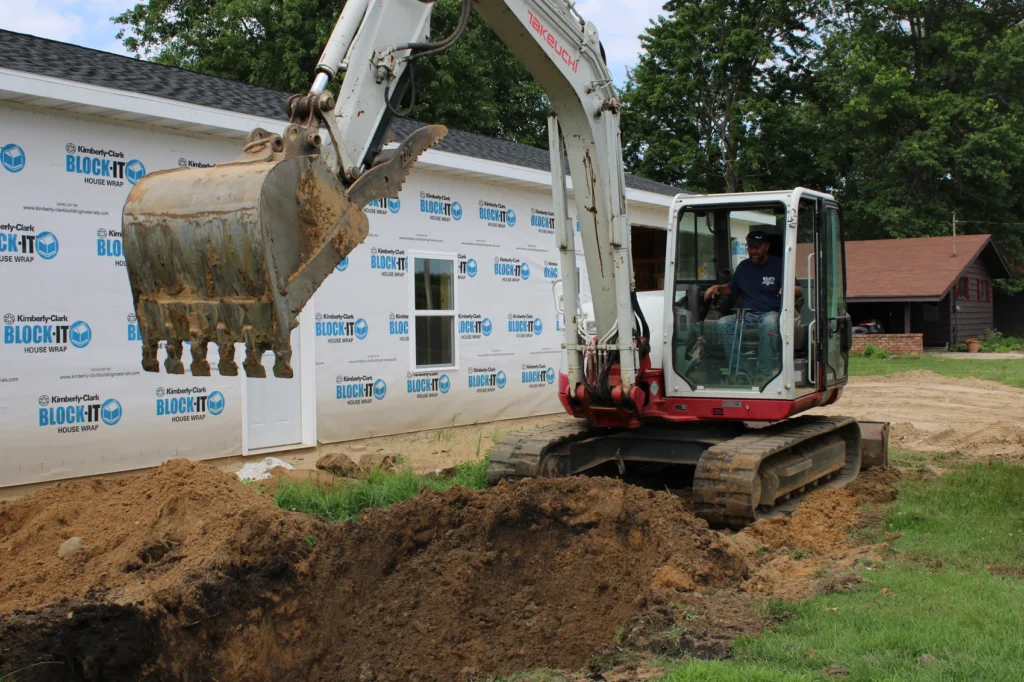
The real bottleneck wasn’t labor or permitting. It was shipping. The system took six months to arrive from overseas, which ate into a timeline that was already tight. Once it was on site, the build-over-existing-bed approach moved forward without pushback, from the health department or within our own team.
When the work wrapped, both the health department and the property owner were satisfied with the result. It remains one of the larger commercial septic system installations Wray’s has coordinated in Allegan County.
Aerobic Treatment Systems Today
An aerobic treatment unit (ATU) works differently than a standard septic system. Instead of relying only on gravity and the anaerobic (oxygen-free) breakdown that happens in a conventional tank, an ATU adds oxygen to speed up waste treatment before it ever reaches the drainfield. That extra step makes an ATU a common fit for properties like the one in this story: sites with poor soil, tight space, or environmentally sensitive land nearby that rule out a conventional system.
Wray’s has installed other alternative treatment systems since that 2010 project, but hasn’t installed another one quite like this. A site this constrained, on this scale, doesn’t come up often. Most properties with soil or space challenges have more options available to them than a 44-unit commercial site with a lake downstream.
What This Job Still Teaches Us
The lesson applies well beyond a 44-unit commercial site. Alternative systems are a strong option any time a property’s footprint is the constraint. A nearby body of water or a small yard can rule out a conventional system just as easily as soil that won’t support one. This job faced more than one of those constraints at once, but the same logic applies to a single residential lot.
Have a Site That Doesn’t Fit the Standard Playbook?
If poor soil, tight space, or environmental constraints rule out a standard septic system on your property, Wray’s has spent nearly 60 years finding the fix, including alternative septic system options.
Call (269) 673-4791 or schedule a free estimate to talk through options for your site.